Endangered languages in Paris: data collection for Icelandic Sign Language
At the 30th conference of the Foundation for Endangered Languages in Paris, Rannveig Sverrisdóttir and Guðný Björk Þorvaldsdóttir presented our work on collecting data for Icelandic Sign Language.
The opening address
This week I am attending the 30th Annual Conference of the Foundation for Endangered Languages in Paris, hosted by the National Institute of Oriental Languages and Civilisations. The conference co-chairs, Hakim Elnazarov of the Foundation and Abdul Hakim Hamidi of the Institute, gave the opening address, and one passage from Abdul Hakim Hamidi’s part has stayed with me:
Language is far more than a system of communication. It embodies collective memory, cultural knowledge, social relationships, identities and distinctive ways of understanding the world. When a language disappears, we risk losing not only its words, grammatical structures and expressions, but also the unique forms of knowledge, cultural practices and intergenerational connections it carries.
The first day brought talks on languages from all over the world that are struggling in one way or another, and on the many ways linguists, technologists and the communities themselves are working to support and revitalise them.
Our talk
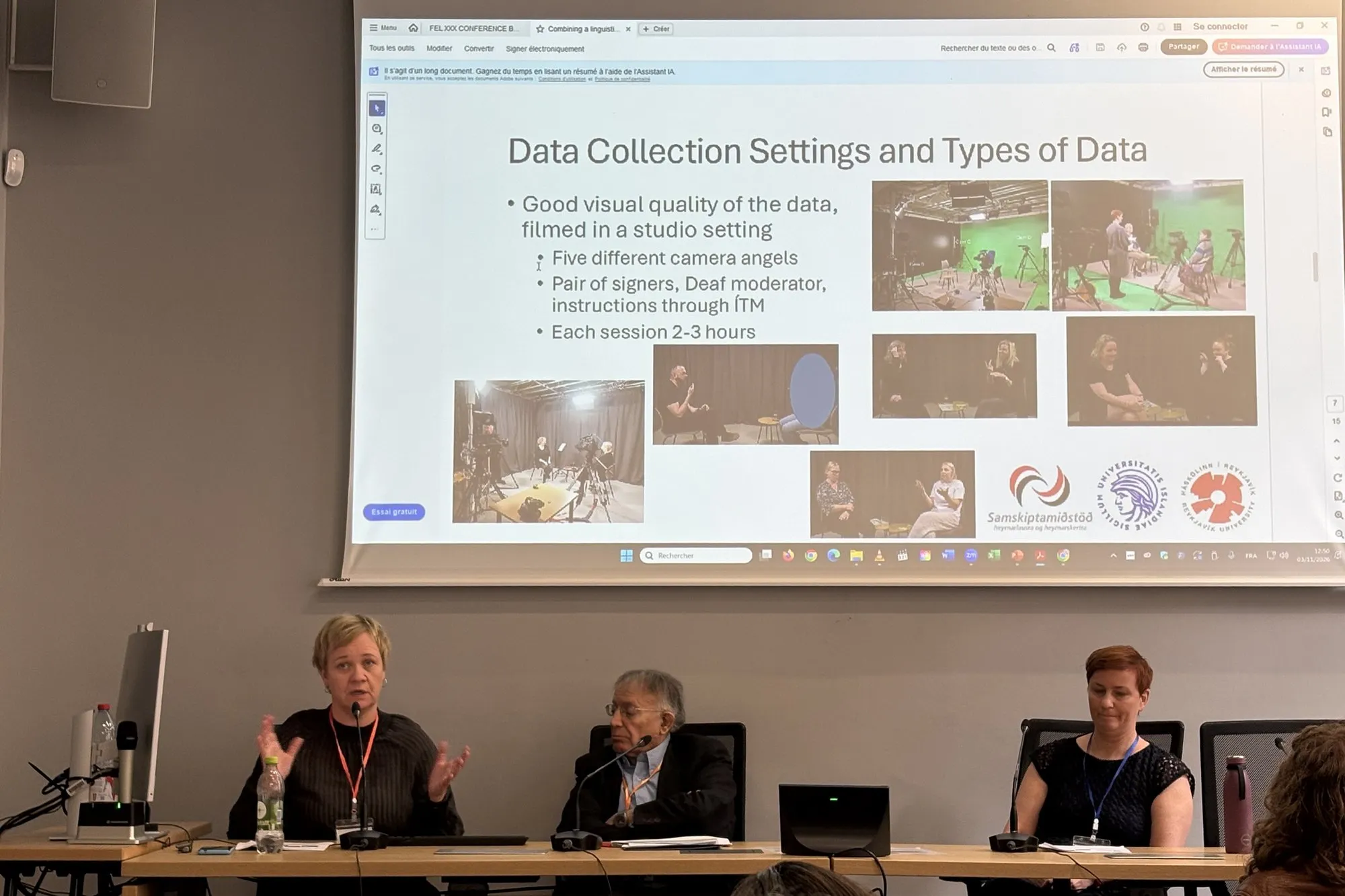
On 3 November, Rannveig Sverrisdóttir and Guðný Björk Þorvaldsdóttir presented our paper, Combining a Linguistic Corpus and Language Technology (development). Data collection for Icelandic Sign Language, written with me and Torfi Þórhallsson. They covered the background of the language, the outline of our research project and how the data collection and annotation work has begun.
Icelandic Sign Language has fewer than 300 signers and is threatened. A government committee on the language warned in 2015 that it was endangered, as fluent native signers are becoming fewer.
In our project, Sign and Talk, which I presented at QUT in August, we are gathering parallel video, audio and text so that neural models can be trained to translate between signing, speech and text.
What the attention itself does
The technology the language needs will, in time, support communication within the deaf community and between deaf and hearing people. A less obvious result, and one that arrives sooner, is set out in our abstract:
A project of this kind directs sustained attention and resources at a small community, and this attention carries its own message, that the language is worth the effort. For a community whose language has long been treated as marginal, that recognition matters, and it strengthens the confidence on which any revitalisation ultimately depends.